
English| EUR
Suggested for you
More currencies
Choose a language
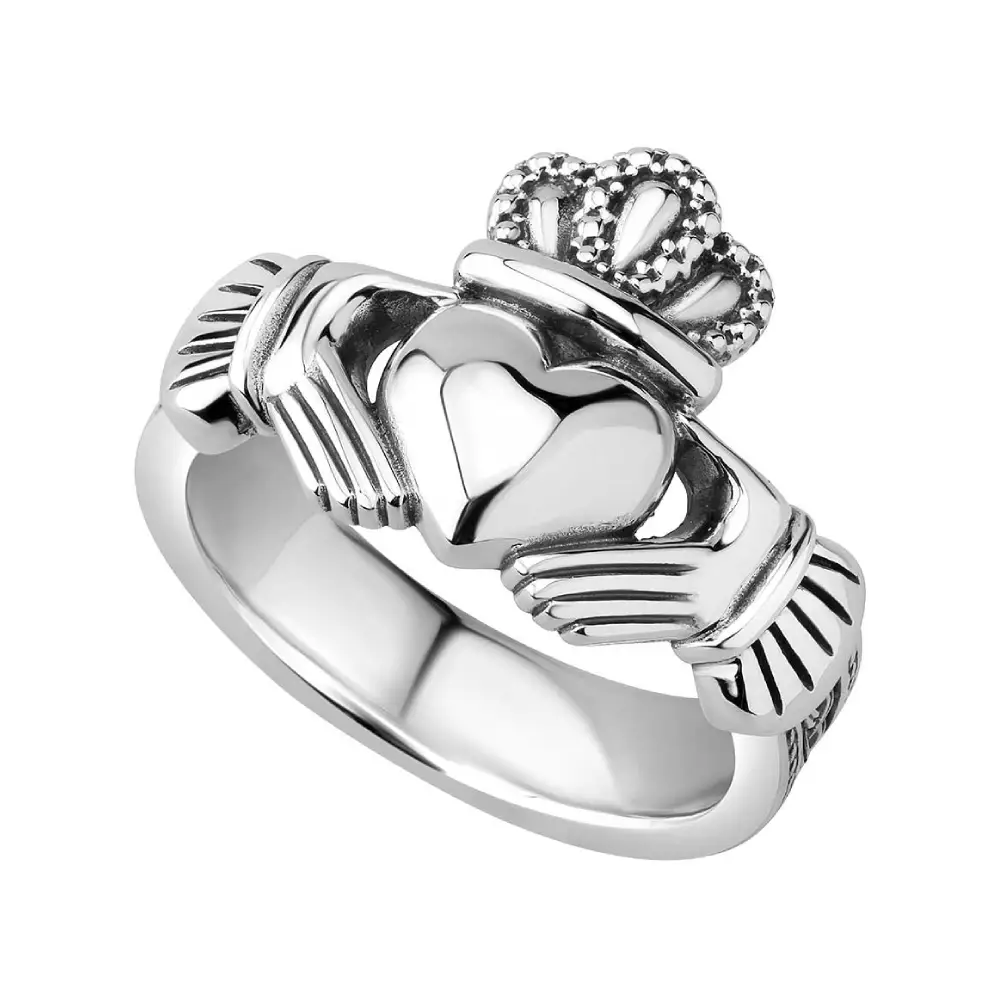
Few pieces of Irish jewellery carry as much unwritten etiquette as this one, and most of it is passed on by hand rather than written down. This irish claddagh ring rules guide sets out what the hand, the finger and the crown direction are understood to signal. It also explains where the conventions came from, and where visitors to the Claddagh Ring Workshop on Shop Street can see them demonstrated in person.
Quick answer
There is no single legal or religious code — the conventions are customary. Worn on the right hand with the crown turned outward, the ring traditionally signals the wearer is unattached; turned inward, it signals a commitment. Moved to the left hand, crown outward, it reads as engaged, and crown inward as married. Regional and family variations are common and equally valid.
The design is unusually well documented for a folk motif: it is named for the fishing village of Claddagh, across the Corrib from Galway city, and the earliest surviving examples carry Galway goldsmiths' marks from the seventeenth and eighteenth centuries. Richard Joyce is the silversmith most often credited with the form, and his mark still appears in accounts of the trade. That documented lineage is why the irish claddagh ring rules are treated as heritage rather than fashion — the hands, the heart and the crown were read as friendship, love and loyalty long before any of it was printed on a card. What visitors are actually dealing with is a set of customs, not a rulebook. The direction of the crown and the choice of hand form a small vocabulary that anyone in Galway will recognise, but the vocabulary shifts by family and by county. Emigration spread the motif through Boston, New York and Liverpool, and each diaspora community bent the conventions slightly. Some households pass the ring down the female line and ignore the hand question altogether. Some jewellers on Shop Street will tell one version; a workshop bench a few metres away may tell another. Neither is wrong. Anyone hoping for a definitive claddagh ring etiquette guide should expect a range rather than a single answer, and should ask the maker directly. That is the practical value of visiting the museum and visitor centre on Shop Street. The exhibits, the goldsmiths' marks on display and the short film cover the history that makes the conventions legible, and the bench work shows how the heart, hands and crown are actually formed in metal. Reading about Galway landmarks is one thing; watching a crown being set is another. For most readers, the conclusion is straightforward. Choose the hand and direction that reflect the situation honestly, accept that a relative may correct the choice, and treat the correction as part of the tradition. The irish claddagh ring rules survive because they are retold, not because they are enforced. Full opening times, admission details and the recommended arrival window are set out in the dedicated sections further down this page.
“The conventions survive because they are retold, not because they are enforced.”
How you wear a Claddagh ring is read as a statement about your relationship status, so the hand and the crown's direction matter more than the ring itself. Getting the orientation wrong in Galway will draw polite questions from locals and shop staff.
The history of the Claddagh ring has led to many interpretations of how it should be worn. While traditional customs exist, modern wearers often choose to wear the ring based on personal preference rather than rigid rules.
MythYou must wear the ring on a specific finger to be valid
FactThere is no official rule requiring the ring to be worn on a particular finger; personal comfort dictates your choice.
MythYou are forbidden from buying your own Claddagh ring
FactIt is a common misconception that you must receive the ring as a gift, but many people purchase their own to celebrate their heritage.
MythWearing the ring incorrectly brings bad luck
FactThere are no superstitions or penalties associated with how you choose to display the ring.
MythCladdagh rings are only for romantic relationships
FactThe ring is frequently worn as a symbol of friendship or cultural identity, regardless of your relationship status.
The Irish Claddagh Ring Workshop on Shop Street is open seven days a week to accommodate visitors.
To experience the museum comfortably, the best arrival window is 09:00–17:00. Arriving during this period allows sufficient time to view the 20-minute movie and explore the exhibits while avoiding peak afternoon crowds.
—
Visit early to enjoy the exhibits before daily visitor numbers increase.
Mild, 15–20°C
Expect busier periods from June through August due to tourism.
Cool, 10–15°C
April and October offer a balance of manageable visitor numbers and comfortable weather.
Verdict: The best slot for a comprehensive visit is Tuesday to Thursday, arriving at 09:00, during the months of April or October.
Everything you need to know about irish claddagh ring rules
The traditional irish claddagh ring rules dictate that the way the ring is worn signifies your relationship status. By following these customs, the wearer communicates whether they are single, dating, engaged, or married to those around them. These guidelines are a core part of the heritage surrounding this iconic Galway jewelry.
To signal that you are single according to irish claddagh ring rules, wear the ring on your right hand with the heart facing outward away from your body. Once in a relationship, you turn the heart to face inward toward your heart to show you are taken. Proper positioning is the primary way to adhere to these local customs.
When you are married, the irish claddagh ring rules state that the ring should be worn on the left hand with the heart pointing toward your fingernail. This placement mirrors the position of a traditional wedding band. Many people choose to wear their authentic piece in this manner to celebrate their union.
For an engagement, you typically wear the ring on the right hand with the heart facing outward. Once the wedding ceremony takes place, you shift the ring to the left hand and rotate the heart inward. These irish claddagh ring rules help ensure your jewelry reflects your current life stage correctly.
The visitor centre provides exhibits and a 20-minute movie detailing the legacy and symbolic meaning of this famous artifact. While the workshop focuses on the creation process, the staff can help you understand the cultural significance behind your hand-crafted piece. You will leave with a deep appreciation for the traditions associated with these gold and silver symbols.
Yes, the exhibits at the Galway location offer a detailed look at the history of the Claddagh design and the legacy of local silversmiths. Visitors can explore the craftsmanship and heritage that makes this jewelry a significant Irish landmark. Plan to spend enough time to fully appreciate these historical displays during your visit.